The short answer
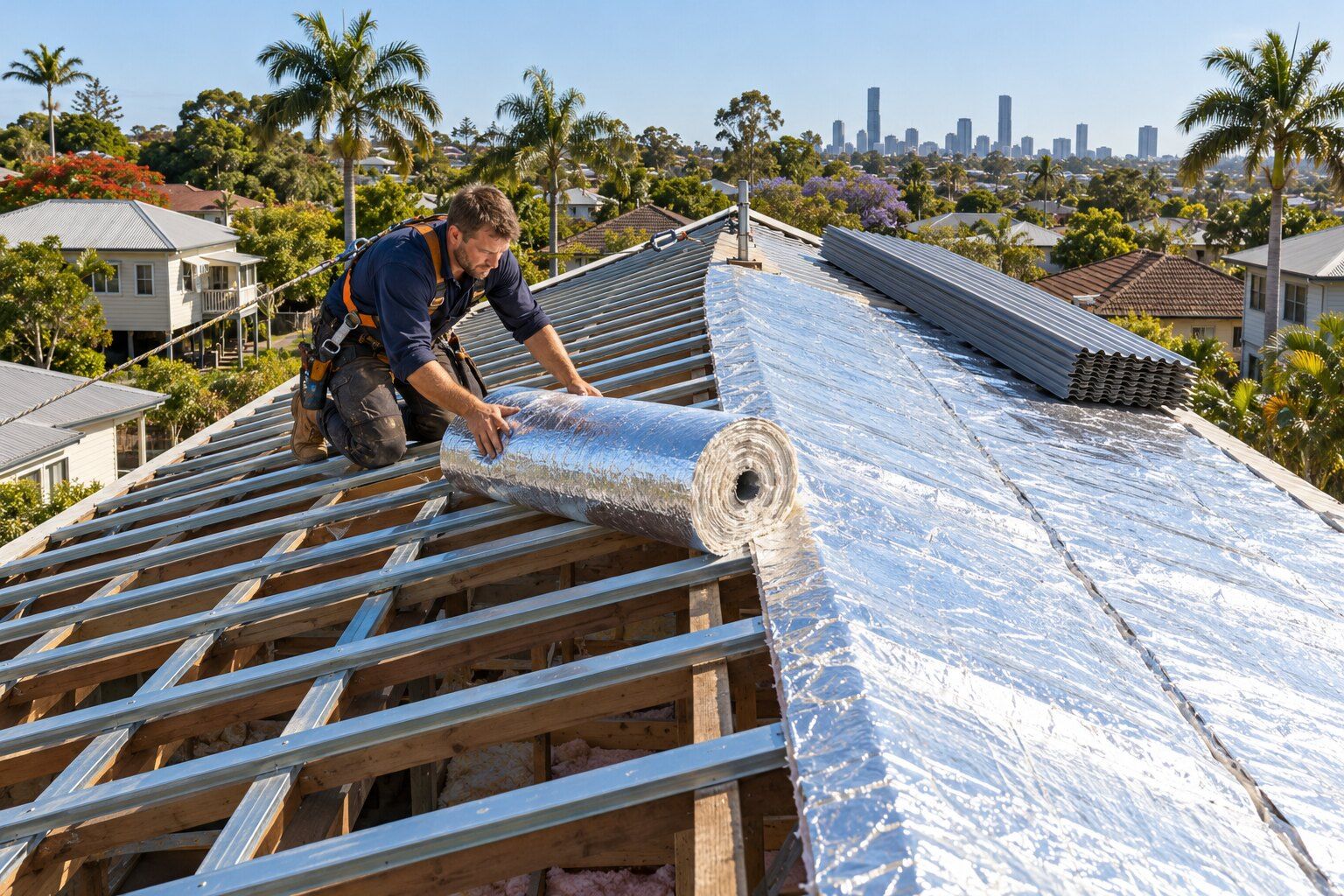
Sarking is a flexible membrane, usually foil-faced, laid over the rafters under the battens. Under tiles it’s a second skin against wind-driven rain and dust, and the code’s deemed-to-satisfy tile provisions require it on tiled roofs pitched below 18 degrees and on longer rafters at steeper pitches. A roof insulation blanket, such as CSR Bradford’s Anticon, is glasswool with a foil facing, laid directly under metal sheets to cut heat and rain noise; Bradford says Anticon is “Not suitable for use under tiled roofs.” Brisbane is in NCC climate zone 2, where a new house’s ceiling insulation depends partly on what’s under the roof. Existing homes don’t have to meet current rules unless new building work is done, so ask your roofer or certifier what applies to your re-roof. Either way, a re-roof is when sarking or a blanket goes in.
What is roof sarking?
Sarking is a roll of flexible membrane, usually a reflective foil laminate, that the roofer lays over the rafters or trusses before the battens and the tiles or sheets go on. It catches water and dust that get past the roof covering and runs it down to the gutter, and its foil face can work as reflective insulation.
CSR Bradford, one of the main Australian makers, describes sarking as a product that can work “as reflective thermal insulation, a protective second skin against burning embers in a bushfire area or as a way to control condensation”. The building code links the two jobs: “Where sarking is also provided as reflective insulation for the purpose of energy efficiency, Section 13 of the ABCB Housing Provisions contains required R-Values and the necessary airspaces adjoining the reflective insulation.”
Sarking under tiled roofs: when the building code requires it
For new tiled roofs, the ABCB Housing Provisions say “Sarking must— be provided in accordance with Table 7.3.4”, overlapped at least 150 mm or taped, fixed at no more than 300 mm centres, with “no sags more than 40 mm”. The table sets how long a rafter can be before sarking is needed, measured from the ridge down:
Sarking for tiled roofs: longest rafter without sarking
| Roof pitch | Longest rafter or truss top chord without sarking |
|---|---|
| Under 18° | None: all tiled roofs under 18° must be sarked |
| 18° to under 20° | 4,500 mm |
| 20° to under 22° | 5,500 mm |
| 22° and over | 6,000 mm |
ABCB Housing Provisions (NCC 2022), Table 7.3.4 and its notes, checked 23 October 2026. Past the length shown, sarking goes over the rest of the rafter down to the eaves. Where sarking is laid on a roof pitched under 20°, or with no eaves overhang, an anti-ponding board is also required (7.3.5).
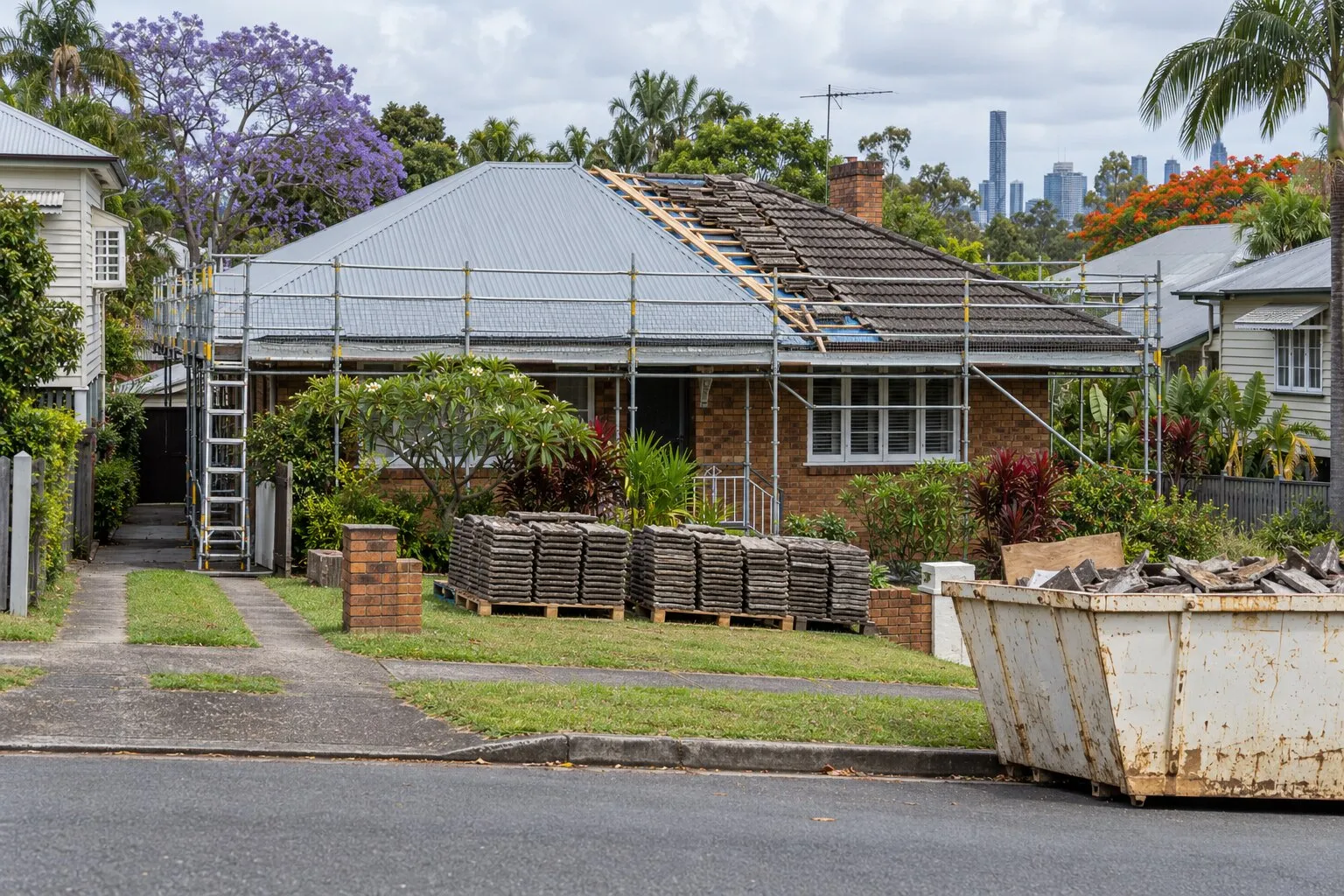
Bradford’s own recommendation goes further: “As a general guide, it is considered good building practice to sark all tiled roofs”. Tile makers set their own minimums too; Monier’s concrete Elabana tile, for instance, goes to 15° with sarking and 20° without. The Colorbond vs tile guide covers roof pitch for each.
Anticon and other roof insulation blankets under metal roofs
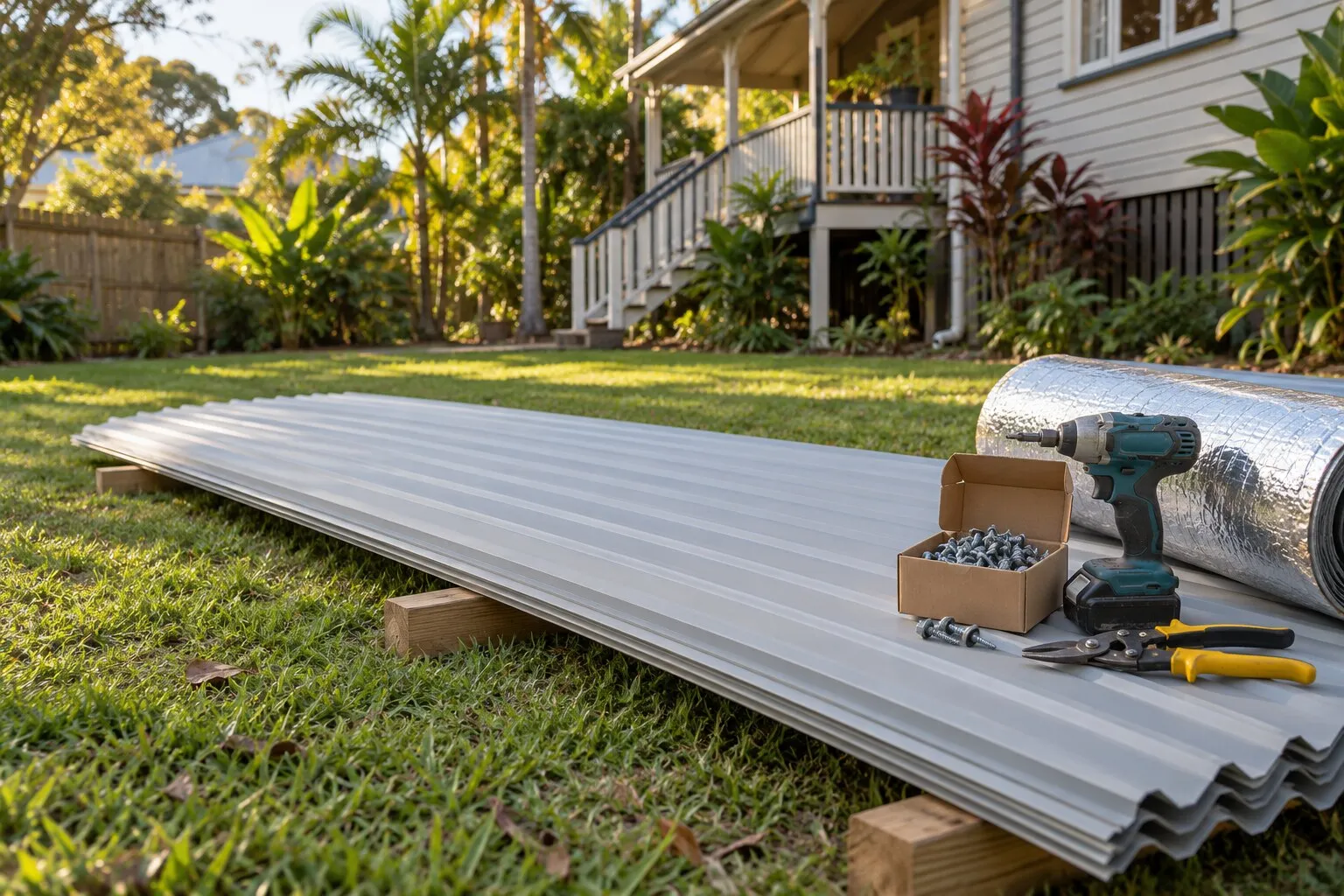
Under a metal roof, the alternative to plain sarking is a roof insulation blanket. CSR Bradford describes Anticon as “an Australian-made, premium foil-faced glasswool insulation blanket” for metal roofs, “Suitable for new builds and re-roofing projects”. Fletcher Insulation’s equivalent, the Permastop Building Blanket, is faced with its Sisalation foil laminate and, Fletcher says, “reduces rain noise”.
Lysaght, the steel roofing maker, explains why it’s laid tight: “an insulation blanket can be placed over the foil laminate described above, before laying the roofing. It is important that the laminate is pulled tight enough to hold the blanket hard against the underside of the roofing to dampen the rain-induced vibration at the point of impact.”
Bradford Anticon blanket thickness and R-value
| Thickness | Material R-value |
|---|---|
| 60 mm | R1.3 |
| 80 mm | R1.8 |
| 100 mm | R2.3 |
| 130 mm | R3.0 |
| 175 mm | R4.2 |
CSR Bradford’s Anticon product page, Light Duty facing rows, checked 23 October 2026. Bradford lists other thicknesses and facings, and a thinner, denser Anticon High Performance range. Its technical statement says that where the blanket is crushed between the metal sheet and the framing it provides R0.2.
Bradford’s technical statement (May 2026) sets limits worth knowing on a Brisbane re-roof. It says Anticon is “Not suitable for use under tiled roofs”, must be “installed dry and remain dry until the roof is completed”, and recommends the roof sheets and flashings go on “within the same workday”. It also says the product “is not suitable for use within 500m of a saltwater body in an unenclosed, ventilated space”. It doesn’t define a saltwater body, so on a riverfront home, ask the roofer to confirm in writing that the blanket quoted suits the site.
Roof insulation R-values for Brisbane (climate zone 2)
Brisbane is in NCC climate zone 2, which Business Queensland describes as “Sub-tropical – warm and mild from central to southern Queensland along the subtropical coast”. For a new house in zone 2 built to the code’s elemental provisions, the ceiling insulation required depends on the roof’s colour (its solar absorptance), whether the roof space is vented, and whether there’s reflective insulation or a blanket under the roof:
Ceiling insulation for new houses in climate zone 2
| Roof space | Under the roof | Ceiling insulation R-value (light to dark roof) |
|---|---|---|
| Standard (not vented) | Reflective insulation | R2.5 |
| Standard (not vented) | No reflective insulation; under-roof insulation below R0.5 | R3.0 to R4.0 |
| Standard (not vented) | No reflective insulation; under-roof insulation R0.5 to under R1.0 | R2.5 to R3.0 |
| Standard (not vented) | No reflective insulation; under-roof insulation R1.0 or more | R2.5 |
| Vented | Reflective insulation | R2.5 |
| Vented | No reflective insulation; under-roof insulation below R0.5 | R2.5 to R3.5 |
| Vented | No reflective insulation; under-roof insulation R0.5 or more | R2.5 |
ABCB Housing Provisions (NCC 2022), Table 13.2.3c, checked 23 October 2026. Where a range is shown, the lower figure is for the lightest roof colours and the higher for roofs with a solar absorptance between 0.42 and 0.64. The code counts a roof as vented with one wind-driven ventilator per 50 m² of ceiling, or one powered ventilator per 200 m², plus gable, eave or ridge vents, or a tiled roof with no sarking. The R-value of reflective insulation isn’t added to the ceiling insulation’s.
The same Part says that “In climate zones 1 to 5, the solar absorptance of the upper surface of a roof must not be more than 0.64”, and Business Queensland says new houses have had to meet the NCC 2022 energy standards, including a seven-star energy rating for most houses and townhouses, since 1 May 2024; a house assessed on that rating takes that path instead of the table above. Condensation rules that call for vapour-permeable sarking apply only in climate zones 6 to 8, not Brisbane.
Do these apply to your re-roof? The ABCB says “Existing homes were built to meet the NCC requirements that applied at the time they were built. They do not need to meet current NCC standards unless new building work is done”, and that new work “must comply with the NCC edition that applies at the time the work is approved.” Whether a particular re-roof counts depends on its scope and approval, so ask your roofer or a building certifier before relying on any R-value.
Electrical safety in the roof space
Queensland’s Electrical Safety Regulation 2026 says a business must ensure, so far as is reasonably practicable, that a worker doesn’t work in or enter a house’s roof space unless “the relevant electrical installation for the building is de-energised”, apart from limited exceptions. The Electrical Safety Office puts it plainly: “if you have a tradesperson coming to work in your roof space, they will be required to switch off the power at the main switchboard before they can enter the roof space.”
For anyone going up there, the office adds: “When you’re up in the roof space, even with the power off, avoid contact with electrical cables and equipment as some circuits may still be live”, and “Check that insulation material in your ceiling is not covering electrical fittings, especially down lights.” Before electrically conductive insulation is laid in a ceiling, the Regulation requires a certificate from a licensed electrical contractor that the existing wiring there is electrically safe.
Asbestos in Brisbane roof spaces
The Queensland Government says “In Queensland, asbestos insulation was not used in residential buildings”. Old fibro roof sheets and some other building materials can contain asbestos; the asbestos roofs guide covers those.
Who installs sarking and roof blankets
On a re-roof, the roofer fits the sarking or blanket as part of the job. The QBCC’s roof tiling licence class includes “Install safety mesh, sarking and anti-ponding boards”; metal roofs are installed under the roof and wall cladding class. Building work valued over $3,300 needs a QBCC licence; check the roofer on the QBCC licensee register.
Insulation on its own is treated differently: the QBCC Regulation lists “Work consisting of the preparation for, or installation of, insulation for acoustic or thermal control” among work that is not building work. The QBCC also lists insulation among the items its home warranty doesn’t cover for defects. What to look for in a roofer and a contract is in the guide to choosing a roofer.
Roof sarking and insulation costs in Brisbane
Few Brisbane roofers publish a separate price for a roof blanket or sarking; the figures that are published are below. Ask for it as its own line, with the brand, product, R-value and thickness, so you can compare quotes.
Roof insulation and sarking prices in Brisbane
| Work | Published price | Who publishes it |
|---|---|---|
| Roof insulation on a metal re-roof, per m² of roof area (type not stated) | $12 – $22 | A.M.J Metal Roofing (Capalaba) |
| Colorbond re-roof including building blanket, battens and sarking, per m² | $107 – $149 | Gutter and Roof Repairs |
| Ceiling insulation batts, installed, per m² (low / typical / high) | $12 / $20 / $35 | whatsthedamage.com.au |
| Reflective foil insulation, per m² (low / typical / high) | $8 / $14 / $22 | whatsthedamage.com.au |
Checked 23 October 2026. A.M.J Metal Roofing is a Capalaba contractor (Redland City, not Brisbane City); its roof insulation page (updated 21 January 2026) doesn’t say whether the figure is supply and install or includes GST, and a later A.M.J cost post gives a different figure for sarking. Gutter and Roof Repairs is a Brisbane and Ipswich contractor; its whole-roof rate (updated 14 October 2025) bundles the blanket and sarking with the new sheets and doesn’t state GST. whatsthedamage.com.au is a national cost-guide website that sells listings to tradespeople; its Brisbane insulation rows (updated 9 October 2026) include GST and are for insulation installers’ ceiling work, not a blanket fitted by a roofer. We found no published price from a Brisbane City roofer for an Anticon-type blanket as its own line, or for sarking on a re-tile.
Whole re-roof prices per square metre are in the roof replacement cost guide.
Common questions
What is sarking on a roof?
A flexible membrane, usually a reflective foil laminate, laid over the rafters or trusses under the battens and the tiles or sheets. It catches water and dust that get past the roof covering and can also act as reflective insulation.
Is Anticon the same as sarking?
No. Anticon is CSR Bradford’s foil-faced glasswool insulation blanket for metal roofs. Sarking is a thinner membrane, often foil, mainly used as a second skin under tiles. A blanket’s foil facing can do the reflective job of sarking too.
Can Anticon go under a tiled roof?
Not according to CSR Bradford: its technical statement says Anticon is “Not suitable for use under tiled roofs.” Tiled roofs take sarking.
What R-value does a roof need in Brisbane?
For a new house in climate zone 2, the code sets the ceiling insulation from R2.5 to R4.0, depending on the roof colour, ventilation and what’s under the roof. With reflective insulation or a blanket under the roof, the table asks for R2.5. Existing homes don’t have to meet current rules unless new building work is done.
Does a re-roof have to meet the current insulation rules?
The ABCB says existing homes don’t need to meet current NCC standards unless new building work is done, and new work must comply with the edition in force when it’s approved. Whether your re-roof counts depends on its scope and approval, so ask your roofer or a building certifier.
Where this information comes from
The prices, rules and advice on this page come from these published pages, checked on 23 October 2026.
- ABCB Housing Provisions (NCC 2022), Part 7.3 Roof tiles and shingles · Australian Building Codes Board, NCC 2022 (in force in Queensland until NCC 2025 is adopted on 1 May 2027)
- ABCB Housing Provisions (NCC 2022), Part 13.2 Building fabric · Australian Building Codes Board, NCC 2022
- ABCB Housing Provisions (NCC 2022), Part 10.8 Condensation management · Australian Building Codes Board, NCC 2022
- ABCB: how the NCC applies to your home · Australian Building Codes Board homeowner page, undated
- Business Queensland: building in Queensland’s climate zones · Queensland Government, last reviewed 17 July 2025
- Business Queensland: energy equivalence building standards · Queensland Government, last updated 14 August 2026
- CSR Bradford: Anticon and Anticon High Performance roofing blanket · CSR Bradford product page (manufacturer), undated
- CSR Bradford: Anticon and Anticon HP roofing blanket product technical statement (PTS024) · CSR Bradford technical statement (manufacturer), May 2026
- CSR Bradford: sarking and the Building Code of Australia · CSR Bradford article (manufacturer), undated
- CSR Bradford: sarking for metal roofing · CSR Bradford article (manufacturer), undated
- Fletcher Insulation: Permastop Building Blanket · Fletcher Insulation product page (manufacturer), updated 19 June 2026
- Lysaght: rain noise considerations for steel roofs · Lysaght (BlueScope) technical page, last updated 18 May 2026
- Electrical Safety Regulation 2026 (Qld) · Queensland legislation, in force from 1 September 2026
- Electrical Safety Office: safety in the ceiling (brochure) · Queensland Electrical Safety Office brochure (PDF created June 2025)
- Queensland Government: how was asbestos used? · Queensland Government, asbestos.qld.gov.au (no page date shown)
- QBCC: roof tiling licence class · Queensland Building and Construction Commission, last reviewed 31 August 2021
- Queensland Building and Construction Commission Regulation 2018, schedule 1 · Queensland legislation, version in force from 1 September 2026
- QBCC: home warranty for defective work claims · Queensland Building and Construction Commission, last reviewed 24 January 2024
- A.M.J Metal Roofing: roof insulation Brisbane · Roofing contractor in Capalaba (Redland City), published 6 October 2024, updated 21 January 2026
- Gutter and Roof Repairs: calculate cost · Brisbane and Ipswich roofing contractor, published 26 June 2023, updated 14 October 2025
- whatsthedamage.com.au: insulation cost Brisbane · National cost-guide website with Brisbane rows, published 15 January 2026, updated 9 October 2026