The short answer
Check the roofer’s licence on the QBCC licensee register, and its class: roof tiling for tile roofs, roof and wall cladding for metal roofs, and painting and decorating if the roof is being painted. The QBCC recommends getting more than one quote and comparing the same scope. For work over $3,300 the law requires a written, dated and signed contract with the roofer’s licence number, the price and the completion date; the deposit is capped at 10% under $20,000 and 5% from $20,000; you have 5 business days to withdraw; and variations must be agreed in writing before the work starts. For residential work over $3,300, home warranty insurance is included in the price, and a defect that lets water into the house counts as a structural defect.
Check the roofer’s QBCC licence and its class
In Queensland, building work “valued over $3,300” needs a QBCC licence, and the licence has to be in the right class for the job. The QBCC says it’s the owner’s responsibility to check that the person is licensed for the work.
QBCC licence classes for roofing work
| Job | Licence class | What the class covers |
|---|---|---|
| Concrete or terracotta tile roofs | Roof tiling | Cutting and fixing roof tiles, battens, bedding and pointing, sarking and anti-ponding boards, skylights, and refurbishing and maintaining roofs, excluding painting |
| Metal and Colorbond roofs | Roof and wall cladding | Roof cladding other than concrete and terracotta tiles, rainwater goods, external flashings and fascias, and refurbishing and maintaining roofs, excluding painting |
| Gutters and fascias only | Metal fascias and gutters | Rainwater goods, metal fascias and gutters, and external flashings |
| Painting or coating a roof | Painting and decorating | Applying paint or other substances, and preparing surfaces |
| Building work on a house generally | Builder (low rise) | Building work on a class 1 or class 10 building |
QBCC licence class pages (last reviewed August 2021) and the QBCC Regulation 2018, schedule 2 (version in force from 1 September 2026), checked 23 October 2026. Both roofing classes exclude painting roofs, so a restoration that includes coating the roof needs that part covered by a painting and decorating or builder licence when it’s over $3,300.
Search the QBCC licensee register by licence number, surname or company name. The QBCC suggests opening the “licensee’s full history” to see “any infringement notices, directions to rectify work or other disciplinary actions recorded”, and says the name and licence number in the roofer’s ads must match the licence. Licences come “as a physical card and as a digital licence on a mobile device”; ask to see one, and if you can’t find the roofer on the register, the QBCC takes calls on 139 333.
Roofers who only advertise small jobs can work without a licence up to $3,300, and the QBCC says they “must state in their ad they can only do work up to that value.”
Comparing roofing quotes
The QBCC says “we always recommend getting more than one quote”, and “To compare quotes fairly, make sure they cover the same scope of work.” It warns against choosing on price alone, and adds: “If you accept a quote that is below fair market value and need to make a claim under the QHWS the amount of compensation you receive may be reduced.”
Questions the QBCC suggests asking about any quote:
- “Are there any additional fees or charges I should be aware of?”
- “Are contingencies (unexpected costs) included in the quote? If so, how much?”
- “Does the price include all required certifications, inspections and fees?”
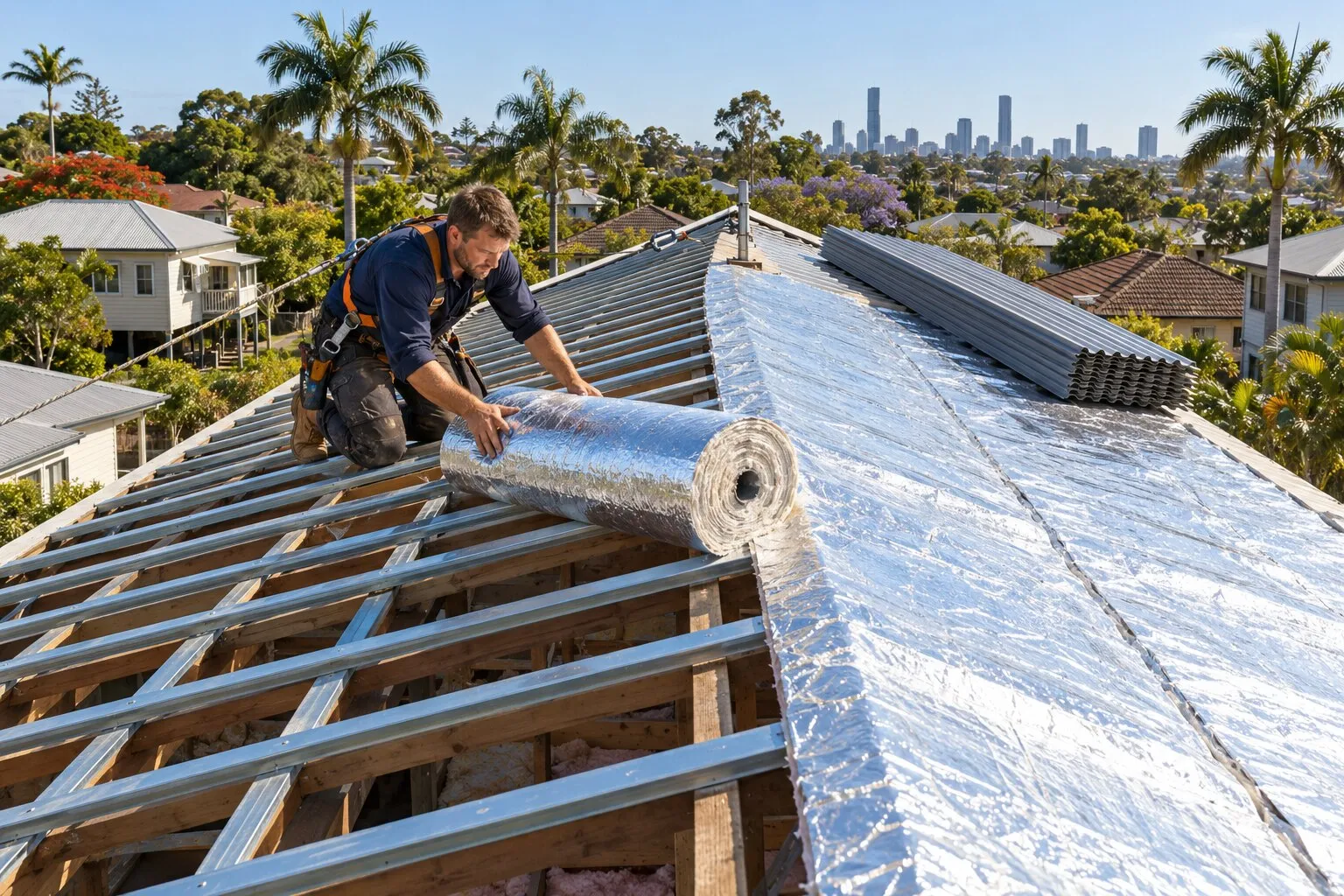
For a roof, our advice is to ask each roofer to itemise the same things: the roof sheets or tiles (brand, profile and colour), battens, sarking or insulation blanket, flashings and ridge capping, gutters and downpipes if they’re included, scaffold or edge protection, the skip, and any engineering or certification. The sarking and insulation guide explains the layer under the roof.
What a roofing contract must include in Queensland
Roofing work over $3,300 on a home is a “regulated contract” under schedule 1B of the QBCC Act, and “The contract must be in writing and dated and signed by or on behalf of each of the parties to it.” It must contain:
- the names of the parties, with the roofer’s name as it appears on the licence, and the licence number
- a description of the work, and any plans and specifications
- “the contract price or the method for calculating it, including the building contractor’s reasonable estimate”
- the date for practical completion, or how it will be worked out
- a conspicuous notice of your right to withdraw from the contract (the cooling-off period below)
From $20,000 (a level 2 contract), it must also state the start date and the statutory warranties, and the roofer must give you the QBCC’s consumer building guide before you sign. If the price is fixed, “it must be stated in a prominent position on the first page of the contract schedule”. The roofer must give you a signed copy within 5 business days, and can’t start work until the contract complies. The QBCC has contract templates, including a two-page small building projects contract for jobs under $3,300.
Deposits, progress payments and cooling-off
Before work starts, the deposit can be no more than 10% of the price for a contract over $3,300 and under $20,000, and 5% from $20,000 (QBCC Act schedule 1B s 33; the hail damage and insurance guide has the table). The QBCC says “A deposit isn’t required until you have signed a contract”, and that deposits over the limit “are unlawful, must not be paid and should be reported to the QBCC”. After the deposit, each claim must be “directly related to the progress of carrying out the subject work at the building site” and proportionate to the work done.
You can withdraw “within 5 business days after the day on which the owner receives a copy of the signed contract”, by a signed written notice; the roofer can keep reasonable out-of-pocket expenses plus $100. For an urgent roof repair, the Act lets the owner of “a repair contract” waive this right in a signed written notice so work can start sooner. Door-to-door agreements have their own 10-business-day rules, covered in the hail guide.
Variations: rotten battens and other surprises
Once an old roof is off, the roofer may find rotten battens or rafters, rusted fixings or a failed tie-down. Extra work like this is a variation. The Act says the roofer “must not start to carry out any domestic building work the subject of the variation before the building owner agrees to the variation in writing”, apart from genuinely urgent work.
The written variation has to describe the change, state the change to the price (or how it’s calculated) and any delay, and “Any increase in the contract price as a result of the variation can not be required to be paid before work the subject of the variation is started.” Our advice: ask for photos of anything found and keep every variation with the contract.
Home warranty insurance and defective roof work
For residential work over $3,300, the roofer pays a Queensland Home Warranty Scheme premium to the QBCC, collected from you as part of the contract price. The QBCC says it covers you “if your contractor does not, or can not, finish the work”, “if your contractor does not fix defects” and for subsidence, up to “a maximum of $200,000 on claims”, with limitations and exclusions.
For roofs, one definition matters: the QBCC Regulation counts “a defect in the work that allows water penetration” of a home as a structural defect. Structural defects are covered if you become aware of them within 6 years and 6 months, and you must claim “within 3 months after the day the consumer first becomes aware”. Other defects are covered for 6 months after the work is substantially complete, with claims within 7 months. The QBCC lists insulation among the items not covered for defects.
Time limits for defective roof work in Queensland
| What | Time limit |
|---|---|
| Home warranty claim, structural defect (including a leak into the home) | Within 3 months of noticing; cover runs 6 years and 6 months |
| Home warranty claim, other defects | Within 7 months of the work being completed; cover runs 6 months |
| QBCC complaint, non-structural defect | No later than 12 months from completion of the work |
| QBCC complaint, structural defect | Within 12 months of noticing; the QBCC can direct a fix up to 6 years and 6 months after completion |
QBCC Regulation 2018, schedule 6 s 16 (version in force from 1 September 2026) and the QBCC’s home warranty and defective work pages (January 2024 and December 2025), checked 23 October 2026. The QBCC says there is no defects claim if you unreasonably refuse to let the roofer come back to fix the work.
The Act also gives you statutory warranties: the roofer warrants the work “will be carried out— (a) in an appropriate and skilful way; and (b) with reasonable care and skill.” Before going to the QBCC, give the roofer written notice of every defect with a date to fix it.
Safety on the roof: what Queensland law asks of roofers
Queensland’s Work Health and Safety Regulation sets fall controls for roof work. Its stricter rules apply on any roof “with a slope over 26º”, and where a person could fall 3 m or more on housing construction work, or 2 m or more on other construction work. There the business must, before work starts, use control measures “to prevent a person falling any distance” or, if that isn’t practicable, to arrest the fall. The measures it lists include edge protection, covers over openings, travel-restraint and harness systems, fall-arresting platforms and safety nets.
Ask each roofer how they’ll manage falls on your house. On a highset Queenslander or a two-storey house, expect scaffold or edge protection to be part of the quote.
Insurance to ask the roofer about
Beyond home warranty, the QBCC says “Most contracts require the contractor to have: Public liability insurance; Contract works insurance (also known as construction works insurance).” Contract works insurance “covers the site and materials against theft, vandalism, fire, storm, etc.” during the job. Our advice: ask for the certificates of currency and check the dates cover your job.
Common questions
What licence does a roofer need in Queensland?
For building work valued over $3,300, a QBCC licence in the right class: roof tiling for concrete or terracotta tiles, roof and wall cladding for metal roofs, and painting and decorating for painting a roof. A builder (low rise) licence also covers building work on a house.
How do I check a roofer’s QBCC licence?
Search the QBCC licensee register by licence number, name or company, and open the licensee’s full history for any directions to rectify or disciplinary action. Ask to see the licence card or digital licence, and call the QBCC on 139 333 if you can’t find them.
How much deposit can a roofer ask for?
Under the QBCC Act, no more than 10% for a contract over $3,300 and under $20,000, and 5% from $20,000. The QBCC says a deposit isn’t required until you’ve signed a contract.
Can I cancel a roofing contract after signing?
For a contract over $3,300, you can withdraw within 5 business days of receiving the signed copy, by signed written notice; the roofer can keep reasonable out-of-pocket expenses plus $100. On a repair contract, you can waive this in writing so urgent work starts sooner.
Is a roof leak after a re-roof covered by home warranty?
For residential work over $3,300 by a licensed contractor, the QBCC Regulation treats a defect that lets water into the home as a structural defect, covered if you become aware of it within 6 years and 6 months. You must claim within 3 months of noticing it, and the roofer has to be given the chance to fix it.
How many roofing quotes should I get?
The QBCC always recommends more than one, compared on the same scope of work, and warns that accepting a quote below fair market value can reduce home warranty compensation.
Where this information comes from
The prices, rules and advice on this page come from these published pages, checked on 23 October 2026.
- QBCC: roof tiling licence class · Queensland Building and Construction Commission, last reviewed 31 August 2021
- QBCC: roof and wall cladding licence class · Queensland Building and Construction Commission, last reviewed 31 August 2021
- QBCC: painting and decorating licence class · Queensland Building and Construction Commission, last reviewed 31 August 2021
- QBCC: find a licensed contractor · Queensland Building and Construction Commission, last reviewed 12 December 2025
- QBCC: seeking and comparing quotes · Queensland Building and Construction Commission, last published 17 June 2026
- QBCC: contracts and agreement types · Queensland Building and Construction Commission, last reviewed 27 June 2025
- Queensland Building and Construction Commission Act 1991, schedule 1B · Queensland legislation, version in force from 1 February 2026
- Queensland Building and Construction Commission Regulation 2018, schedules 2 and 6 · Queensland legislation, version in force from 1 September 2026
- QBCC: what is home warranty insurance · Queensland Building and Construction Commission, last reviewed 11 May 2025
- QBCC: home warranty for defective work claims · Queensland Building and Construction Commission, last reviewed 24 January 2024
- QBCC: help with defective work · Queensland Building and Construction Commission, last published 12 December 2025
- QBCC: insurance responsibilities · Queensland Building and Construction Commission, last reviewed 26 June 2025
- Work Health and Safety Regulation 2011 (Qld), sections 306C-306E · Queensland legislation, version in force from 29 March 2026
- QBCC licensee register · Queensland Building and Construction Commission’s public register