The short answer
ASIC’s Moneysmart says most home and contents insurance covers storms, including damage from rainwater and hail. ASIC also says damage that is pre-existing, wear and tear, or from a failure to maintain the property is generally excluded, so whether your claim is paid depends on your policy and what the insurer’s assessment finds. Photograph the damage before you clean up, tell your insurer, and get its permission in writing before any repairs. Under the General Insurance Code of Practice, once an insurer has all the information it needs it decides within 10 business days, and within 4 months of the claim apart from listed exceptions. Use a QBCC-licensed roofer and a written contract, and don’t sign with a door-knocker before speaking to your insurer.
Does home insurance cover hail damage and roof leaks?
Moneysmart says: “Most home insurance and contents insurance cover storms. This includes damage caused by lightning, cyclones, strong winds, rainwater, hail and snow.”
The common exclusions are about the roof’s condition before the storm. In its 2023 review of home insurance claims, ASIC wrote: “Damage that is ‘pre-existing’ or due to ‘wear and tear’ or a failure to maintain property in ‘good condition’ is generally excluded from home insurance policies, which are designed to cover damage from unforeseeable events like floods, storms, fires and other accidents.”
So a roof leak can go either way, and the policy wording decides. Moneysmart’s advice: “If you’re not sure what cover you have, ask your insurer or read your policy’s product disclosure statement (PDS).” Damage to the house itself is claimed on home (building) insurance, and damage to your belongings on contents insurance.
Making a roof damage insurance claim, step by step
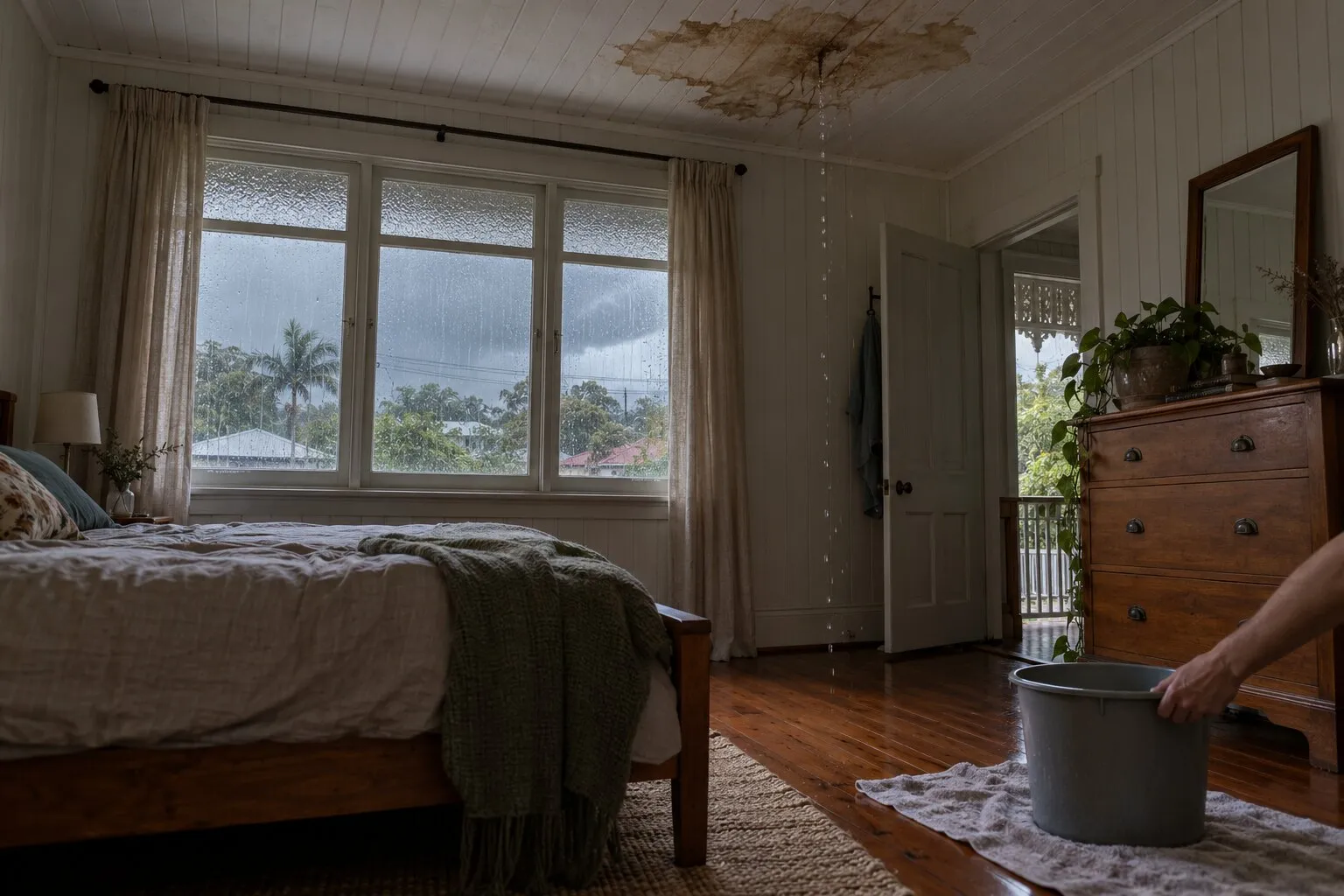
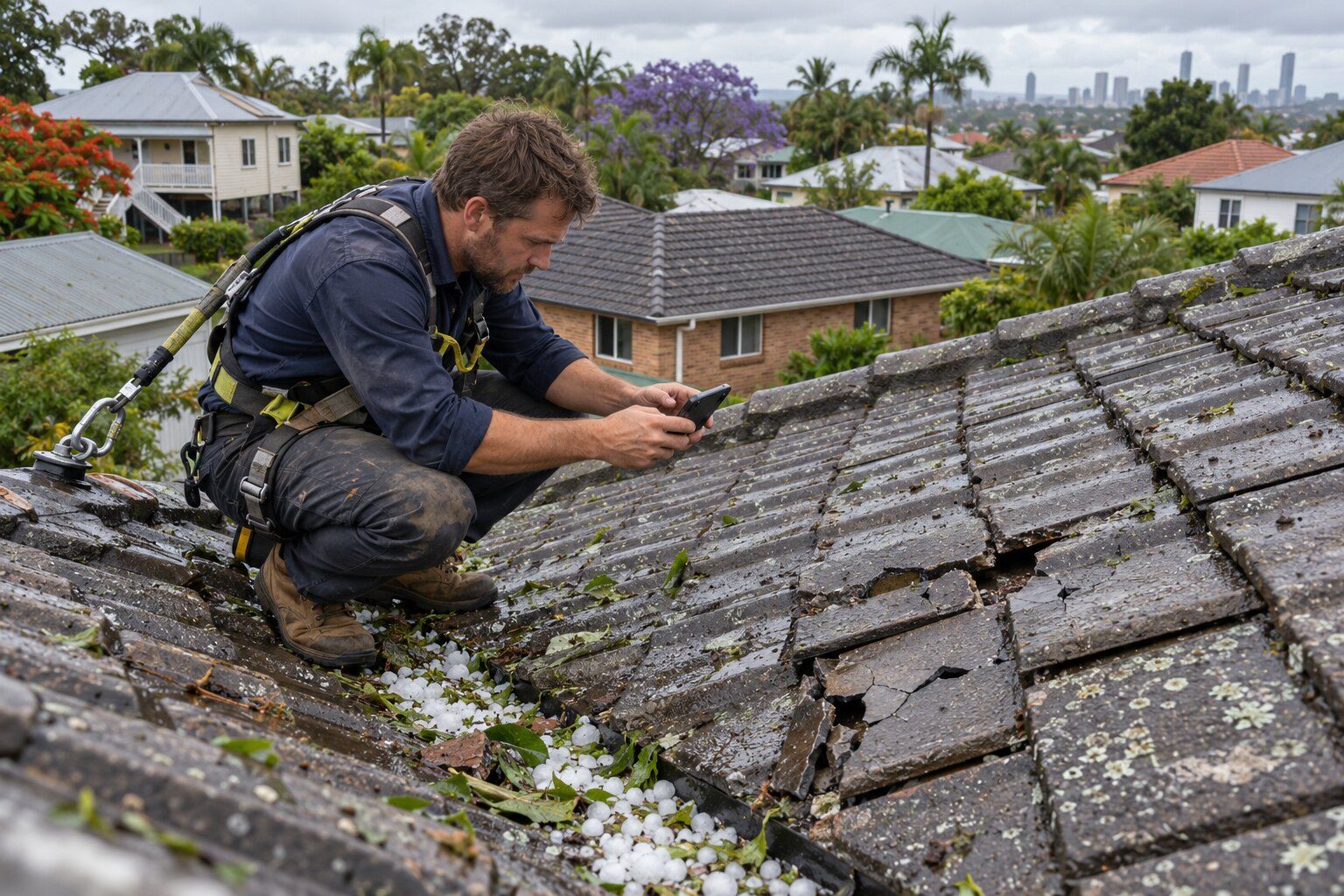
- Photos first. The Insurance Council says: “Before you start your cleanup, document the damage with photos and videos to support an insurance claim.” Photograph the ceilings and rooms too, and keep damaged items unless they’re a health risk.
- Lodge the claim and mention the roof. The Insurance Council’s advice is to “Let your insurer know if you’ve sustained roof damage.”
- Ask before any repairs. Speak to your insurer “before you attempt or authorise any building work, including emergency repairs, and ask for the insurer’s permission in writing, as unauthorised work may not be covered by your policy.”
- Temporary work. Moneysmart says “Many insurers have preferred repairers and suppliers and can arrange emergency repairs for you. This can include things like removing loose debris or installing a roof tarp.” For storm damage you can’t make safe, the SES helps on 132 500 (see the storm damage page).
- The assessment. The insurer may send a loss assessor or loss adjuster and, for a building claim, prepare a scope of works. Keep a record of every call, the claim number and who you spoke to.
- Your own quote and photos. A written, itemised quote and photos from a licensed roofer give you something to compare with the insurer’s scope. It’s your record; the insurer decides the claim.
Hail damage isn’t always visible from the ground. The Insurance Council’s 2025-26 catastrophe report notes that “roof and building damage not always immediately apparent, meaning claims can emerge months later as inspections and repairs progress.” If you suspect damage after a big storm, get the roof checked and tell your insurer.
How long an insurer has to decide a roof claim
If your insurer subscribes to the General Insurance Code of Practice (ask, or check its policy documents), the Code sets these timeframes for claims:
Claim timeframes under the General Insurance Code of Practice
| Step | What the Code says |
|---|---|
| If more information or an assessment is needed | Within 10 business days of receiving your claim, the insurer tells you what it needs, appoints an assessor or adjuster if necessary, and estimates the timeframe and process |
| Loss assessor or adjuster appointed | Within 5 business days, the insurer tells you it has appointed them and what their role is |
| Progress updates | At least every 20 business days; routine enquiries answered within 10 business days |
| The decision | Within 10 business days of having all relevant information and completing its enquiries, and within 4 months of receiving the claim (with listed exceptions) |
| Extraordinary Catastrophe | Where the claim arises from an event the Code calls an Extraordinary Catastrophe, a decision in writing within 12 months |
| Reports the insurer relied on | Copies within 10 business days if you ask |
General Insurance Code of Practice, current version (last updated October 2023), checked 23 October 2026. The Insurance Council submitted a redrafted Code to ASIC on 22 October 2026; these timeframes may change when it starts.
If the insurer doesn’t decide within 4 months, the Code says it “will tell you in writing about our Complaints process”.
Cash settlement or the insurer’s repairer
An insurer may arrange the repair itself or offer you money instead. The Code says: “If we have selected and directly authorised a repairer to repair your damaged property, then we will accept responsibility for the quality of their work and the materials they use.”
A cash settlement is “an amount of money we offer you to settle all or part of your home building insurance claim”, in the words of the Insurance Council’s fact sheet, which insurers must give you with the offer. It says “You can get your own quotes from qualified experts to estimate how much it would cost to repair or rebuild your property and provide them to us as part of the cash settlement process. You may wish to obtain more than one quote.” If you accept, “you will be responsible for finding, organising, and coordinating tradespeople, as well as paying all invoices and managing the project to repair your property.”
Companies that offer to manage your claim
The Insurance Council’s consumer guide says “Claims management companies are businesses that make a profit from your insurance claim” and “Fees for claims management companies are not covered by your insurance policy.” If you use one, check it holds an Australian Financial Services Licence for claims handling.
Storm chasers and door-knockers after a Brisbane hailstorm
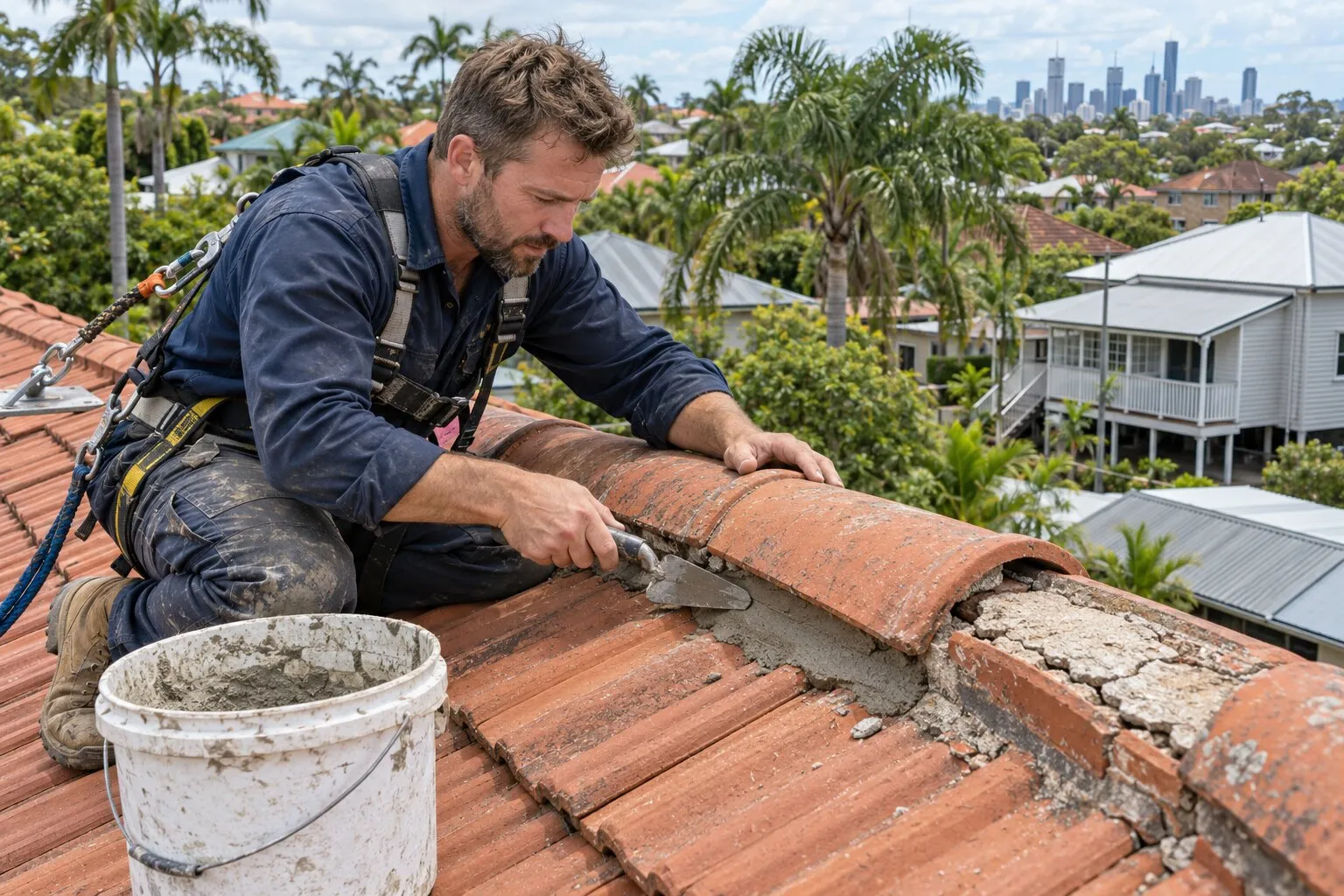
The QBCC has warned of “increased reports of opportunistic individuals after weather events”, and says home owners should “verify a contractor’s licence before signing a contract or paying a deposit”. Its checklist: check the licence on the QBCC licensee register, confirm the person is the licence holder, use “written, dated and signed contracts”, and “Keep records of quotes, contracts and communication.” For repairs after a disaster it says to “Only use QBCC licensed contractors for repair work, so you have cover with the Home Warranty Scheme and access to our dispute resolution service.”
Queensland’s Office of Fair Trading says door-to-door salespeople can call only “between 9am and 6pm” on weekdays and “between 9am and 5pm on Saturdays”, not on Sundays or public holidays. For an agreement over $100 you get “10 business days to change your mind for any reason, without penalty”, and during that time the business can’t supply services or “take any payment or deposit”. There’s a catch after a big storm: “during declared natural disasters the contractual cooling-off period for work associated with the disaster doesn’t apply.”
Maximum deposit for roof repairs in Queensland
| Contract price | Maximum deposit before work starts |
|---|---|
| More than $3,300 and less than $20,000 (level 1) | 10% of the contract price |
| $20,000 or more (level 2) | 5% of the contract price |
Queensland Building and Construction Commission Act 1991, schedule 1B ss 6, 7 and 33 (version in force from 1 February 2026), and Regulation s 45, which sets the level 2 amount at $20,000; checked 23 October 2026. Both levels must be in writing, dated and signed. A higher deposit applies only where off-site work is more than half the contract price.
Hail season in Brisbane
The Bureau of Meteorology says “Queensland’s severe weather season runs from October to April”, and “From October to December, Australia’s east coast, including southern Queensland, has the highest risk of severe thunderstorms”.
The most recent big one was in November 2025. On 25 November 2025 the Insurance Council declared Catastrophe 255 for “the strong winds and damaging hail that impacted South East Queensland” on 23 and 24 November. Its 2025-26 catastrophe report records hail “up to 10 centimetres in diameter” across Bribie Island, Logan, Brisbane’s eastern suburbs and Moreton Bay, and 95,692 claims with $2.2 billion incurred.
If you disagree with the insurer’s decision
Complain to the insurer first. Under the Code it must “make a decision about your Complaint within 30 Calendar Days”, or tell you in writing why it can’t and about your right to go to the Australian Financial Complaints Authority (AFCA). You can take a complaint to AFCA “at any time and if we do not resolve your Complaint within 30 Calendar Days”. AFCA is on 1800 931 678 and at afca.org.au.
Keep your photos, quotes and roof reports together. If the insurer relied on an expert’s report, you can ask for a copy.
Roof inspection and report costs in Brisbane
Roof inspection and report prices in Brisbane
| Service | Published price | Who publishes it |
|---|---|---|
| Roof inspection or report, per visit (low / typical / high) | $200 / $350 / $500 | whatsthedamage.com.au |
Checked 23 October 2026. whatsthedamage.com.au is a national cost-guide website that sells listings to roofers; its Brisbane roofing table (updated 8 October 2026) includes GST. No Brisbane roofer publishes a price for repairing hail damage, which is priced after the roof has been inspected; published repair bands are in the roof repair cost guide.
Published repair prices for cracked tiles, flashings and valleys are in the roof repair cost guide.
Common questions
Does home insurance cover a leaking roof?
It depends on the cause and your policy. Moneysmart says most home insurance covers storm damage, including rainwater and hail. ASIC says damage that’s pre-existing, wear and tear, or from a failure to maintain the property is generally excluded. Ask your insurer or read your product disclosure statement.
Should I get the roof repaired before the insurer approves it?
The Insurance Council says to ask for your insurer’s permission in writing before any building work, including emergency repairs, because unauthorised work may not be covered. Photograph the damage first.
Can I use my own roofer for an insurance claim?
Ask your insurer. If it selects and authorises a repairer, the Code says it accepts responsibility for their work. If it offers a cash settlement, you can get your own quotes and you organise the repair yourself. Either way, a QBCC-licensed roofer’s written quote and photos are a useful record.
How long does an insurer have to decide a hail damage claim?
Under the current General Insurance Code of Practice, within 10 business days of having all the information it needs, and within 4 months of receiving the claim, with exceptions such as what the Code calls an Extraordinary Catastrophe, where the limit is 12 months.
Can I cancel a roof repair contract I signed with a door-knocker?
If the storm isn’t a declared natural disaster, yes: Queensland’s Office of Fair Trading says door-to-door agreements over $100 come with 10 business days to change your mind, and the business can’t take payment or supply services in that time. During a declared natural disaster, the cooling-off period doesn’t apply to work associated with the disaster.
What can I do if my roof claim is refused?
Make a complaint to the insurer, which must decide within 30 calendar days under the Code. If it doesn’t resolve it, or you disagree, you can go to the Australian Financial Complaints Authority on 1800 931 678.
Where this information comes from
The prices, rules and advice on this page come from these published pages, checked on 23 October 2026.
- ASIC Moneysmart: storm, flood and fire insurance · Australian Securities and Investments Commission, updated 18 August 2026
- ASIC Moneysmart: how to make a home insurance claim · Australian Securities and Investments Commission, updated 18 August 2026
- ASIC Report 768: Navigating the storm, ASIC’s review of home insurance claims · Australian Securities and Investments Commission report, August 2023
- General Insurance Code of Practice · Insurance Council of Australia; current Code last updated October 2023 (a redrafted Code went to ASIC on 22 October 2026)
- Insurance Council of Australia: cash settlements under a home building policy (fact sheet) · Insurance Council of Australia fact sheet, 5 December 2025
- Insurance Council of Australia: understanding the cost of claims management companies · Insurance Council of Australia, published 28 January 2026
- Insurance Council of Australia: what to do if your property has been impacted by severe storm · Insurance Council of Australia, updated 24 October 2025
- Insurance Council of Australia: Catastrophe 255, Qld and NSW severe storms and hail · Insurance Council of Australia, published 30 November 2025, updated 7 October 2026
- Insurance Council of Australia: Catastrophe Report 2025-26 · Insurance Council of Australia report, August 2026
- Bureau of Meteorology: now is the time to Get Ready Queensland · Bureau of Meteorology news item, issued 14 October 2026
- QBCC: combating fraud and checking if a licence is legit · Queensland Building and Construction Commission news, last reviewed 9 March 2026
- QBCC: recover from natural disasters · Queensland Building and Construction Commission, last reviewed 3 September 2021, republished 11 December 2025
- Queensland Building and Construction Commission Act 1991, schedule 1B · Queensland legislation, version in force from 1 February 2026
- Queensland Building and Construction Commission Regulation 2018, s 45 · Queensland legislation, version in force from 1 September 2026
- Queensland Office of Fair Trading: door-to-door sales, telemarketing and travelling traders · Queensland Government, last updated 1 July 2026
- QBCC licensee register · Queensland Building and Construction Commission’s public register
- whatsthedamage.com.au: roofing cost Brisbane · National cost-guide website with Brisbane rows, updated 8 October 2026