The short answer
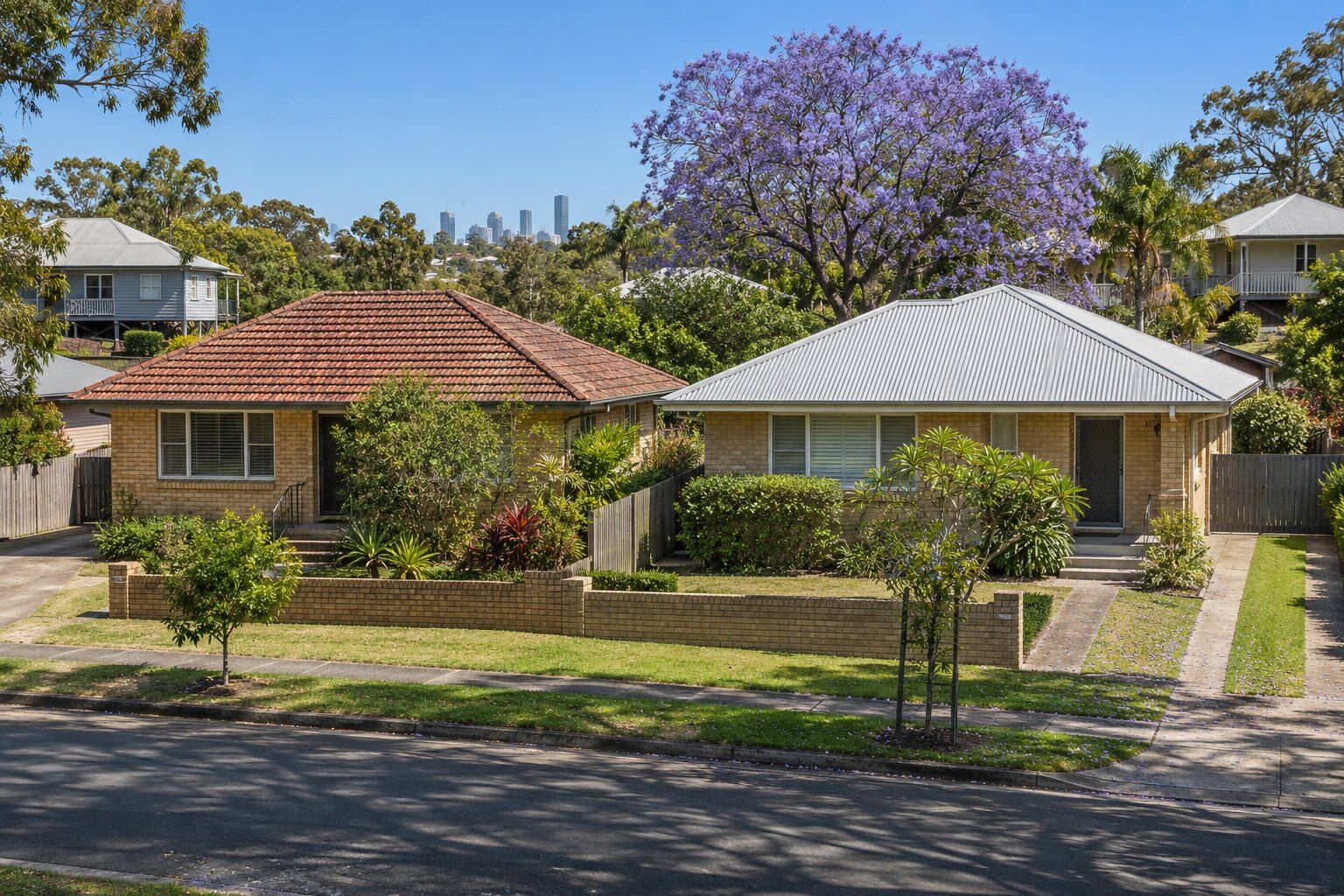
On a Brisbane re-roof the real choice is to restore the tiles, put new tiles on, or switch to Colorbond. Tiles are heavy (Monier publishes 49.5 kg per square metre for its Elabana concrete tile) and need a pitch of about 15 degrees or more; corrugated steel such as Lysaght’s Custom Orb goes down to 5 degrees, but a lighter roof relies on its fixings and tie-down to stay on. For heat, roof colour matters as much as material: for a new Brisbane home built to the code’s elemental provisions, the roof’s solar absorptance can’t be more than 0.64, and BlueScope publishes the figure for every Colorbond colour. Tile roofs need their ridge bedding and pointing kept up; Colorbond needs little beyond washing the areas rain doesn’t reach. On a character house, check the overlay first.
Colorbond vs tiles at a glance
Colorbond steel and roof tiles compared
| Compared | Colorbond corrugated steel | Concrete or terracotta tiles |
|---|---|---|
| Weight | Much lighter; held down by its fixings and tie-down | Monier: 49.5 kg per m² (Elabana concrete), 47.25 kg per m² (Marseille terracotta) |
| Lowest roof pitch | Lysaght Custom Orb: 5° | Monier: 15° with sarking, 20° without (Elabana and Marseille) |
| Roof colour and heat | BlueScope publishes a solar absorptance for each colour, from 0.28 to 0.95 | Monier publishes a solar absorptance for each tile colour |
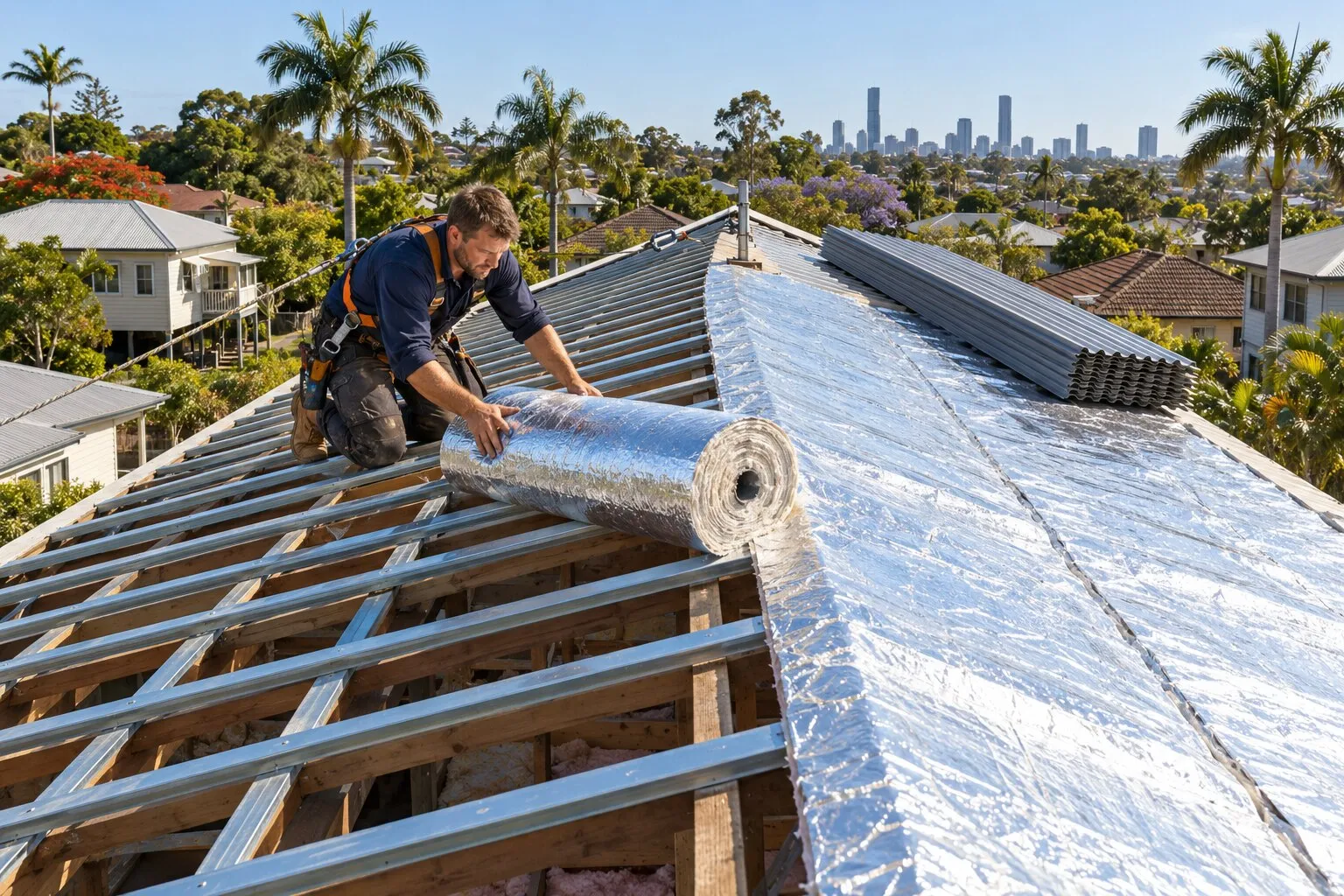
| Under the roof | Insulation blanket laid tight under the sheets for heat and rain noise | Sarking, required on lower pitches and longer rafters |
| Upkeep | Hose down areas rain doesn’t wash at least every six months, more often near the coast | Ridge bedding and pointing, cracked or slipped tiles; concrete tile colour fades |
Monier product pages (November 2025) and FAQ (September 2026); Lysaght Custom Orb page; colorbond.com colour pages (thermal values published August 2022) and FAQ (September 2026); checked 23 October 2026. “Much lighter” is our description; we haven’t been able to re-check a steel sheet weight.
Weight, battens and tie-down
Tiles are heavy. Monier publishes a weight of 49.5 kg per square metre for its Elabana concrete tile (about 11 tiles a square metre) and 47.25 kg for its Marseille terracotta tile. Steel sheets are much lighter, which is one reason people switch: the roof frame carries far less.
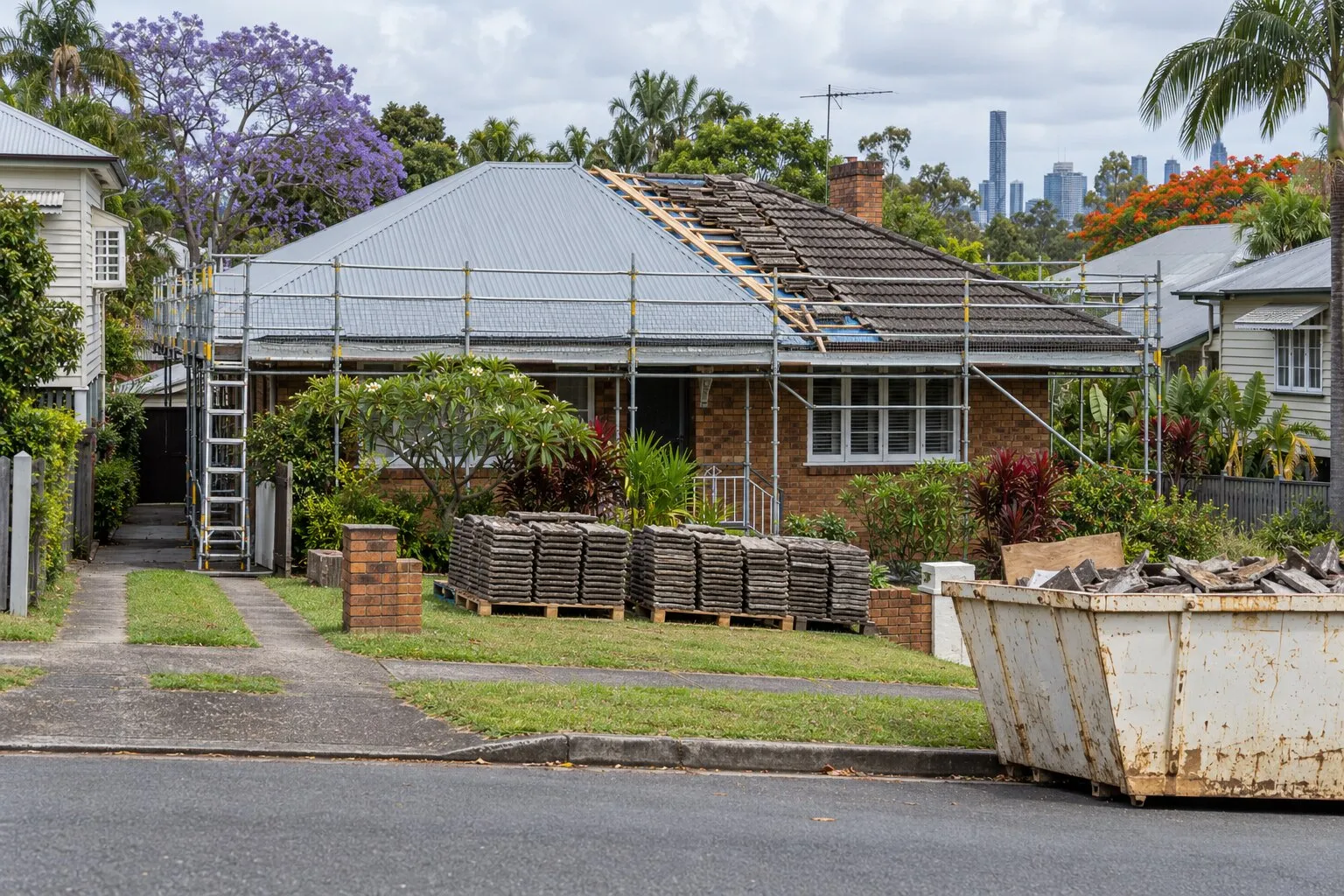
The flip side is wind. A light metal roof stays on through its screws, battens and the tie-down that connects the roof frame to the walls. When tiles come off, ask the roofer whether the battens and tie-downs will be checked and upgraded, and whether the job needs an engineer or a building certifier. Going the other way, from metal to tiles, puts far more weight on a frame that may not have been designed for it; our advice is to have an engineer check the frame first.
Approval rules for roof work are in the roof replacement approval guide, and the conversion itself is on the tile to Colorbond page.
Roof pitch: where tiles can and can’t go
Lysaght lists the “Minimum roof slope” for Custom Orb corrugated steel as 5°. For tiles, Monier says “The minimum pitch for a roof tile varies depending on the profile”; for Elabana it’s “Min with sarking 15°. Min without sarking 20°”. The building code’s own tile provisions apply to roofs pitched between 15 and 35 degrees.
So a low skillion or a flat-pitched extension that suits Colorbond may be too flat for tiles, while a tiled roof can always be changed to metal on pitch alone.
Heat: roof colour matters as much as material
How much of the sun a roof absorbs depends mostly on its colour. For new homes in Brisbane built to the code’s elemental provisions, the ABCB Housing Provisions say “the solar absorptance of the upper surface of a roof must not be more than 0.64”, and a darker roof means more ceiling insulation (see the sarking and insulation guide).
BlueScope says 21 of the core Colorbond colours and the Matt range “feature special Thermatech® solar reflectance technology”, designed “to reflect more of the sun’s heat on hot sunny days”, with results depending on “roof colour, roof shape, level and location of insulation” and the building. Monier publishes a solar absorptance for each of its tile colours, and points to tiles’ “excellent thermal mass, meaning they absorb heat during the day and release it gradually at night.”
Solar absorptance of popular Colorbond roof colours
| Colorbond colour | Solar absorptance (BlueScope) |
|---|---|
| Dover White | 0.28 |
| Surfmist | 0.33 |
| Shale Grey | 0.44 |
| Dune | 0.48 |
| Windspray | 0.60 |
| Wallaby | 0.64 |
| Basalt | 0.67 |
| Woodland Grey | 0.70 |
| Monument | 0.73 |
| Night Sky | 0.95 |
colorbond.com colour pages, checked 23 October 2026. BlueScope says the values are “nominal values based on new product” (thermal values published 23 August 2022). Lower is cooler. For a tile colour, check the figure on the tile maker’s product page.
Rain noise on Colorbond and tile roofs
Steel can be louder than tiles in heavy rain; how much depends on what’s underneath. Lysaght says that “To reduce rain noise on metal roofing, an insulation blanket can be placed over the foil laminate”, pulled tight “to hold the blanket hard against the underside of the roofing to dampen the rain-induced vibration”, and that “If the blanket is not hard against the roofing the noise reduction will not be as good.” Monier, for its part, says “the natural density of tiles significantly reduces external sound”.
Ceiling insulation helps on both. If rain noise is a concern, ask the roofer which blanket and thickness they’re quoting.
Upkeep, repairs and hail
Tile roofs
Monier lists the usual causes of a leaking tile roof as blocked gutters and valleys, “Cracked or broken cement mortar bedding to the ridge or hip capping”, cracked or broken tiles and displaced tiles. It says “respraying your roof is aesthetic only and will not repair your roof”, that the colour coating on concrete tiles “is purely decorative”, and that terracotta tiles “do not fade as the colour is baked into the tile.” After storm damage, broken tiles can be replaced one at a time.
Colorbond roofs
BlueScope says Colorbond “requires minimal maintenance”: areas rain doesn’t wash, like the underside of eave gutters, “should be hosed down at least every six months”. On hail, it says dents “do not typically affect the lifespan” of a Colorbond roof, though deep dents on low-pitched roofs can hold water. The Colorbond lifespan guide has the detail.
Tiles or Colorbond on a character house
Many inner-north houses sit in Brisbane City Plan’s Traditional building character overlay. For work the overlay code assesses, the test is that “Development uses roof materials similar to the roof materials on dwelling houses constructed in 1946 or earlier nearby in the street.” Council’s Traditional Housing design guide notes that on traditional timber houses “Roofs were typically corrugated iron”, and that “Other styles include masonry with brick detailing and tile roofs.”
Our reading: on a pre-1947 timber Queenslander, new corrugated Colorbond in place of old iron is the like-for-like choice. Swapping original terracotta for metal, or iron for tiles, on a character house is the case to check with Brisbane City Council (07 3403 8888) before you get quotes. The re-roofing a Queenslander guide covers the overlay rules.
Cost to restore the tiles, re-tile or switch to Colorbond in Brisbane
On the published figures, a restoration that keeps sound tiles costs the least of the three. Re-tiling and switching to Colorbond both replace the roof covering and are priced per square metre, plus extras such as scaffold, insulation and certification.
Tile restoration, re-tiling and tile to metal prices in Brisbane
| Option | Published price | Who publishes it |
|---|---|---|
| Keep the tiles: typical single-storey tile restoration, per job | $4,500 – $10,000 | Yakka Labour |
| Re-tile in concrete, including strip-off of the old roof, per m² (low / typical / high) | $100 / $150 / $220 | whatsthedamage.com.au |
| Re-tile in terracotta, including strip-off of the old roof, per m² (low / typical / high) | $130 / $190 / $260 | whatsthedamage.com.au |
| Switch to metal: tile to metal base rate, per m², not including insulation, engineering approvals or scaffolding | $100 – $115 | Fortified Roofing Group |
Checked 23 October 2026. Yakka Labour is a labour-hire company’s national cost guide (published 1 October 2026); its Brisbane row includes GST. whatsthedamage.com.au is a national cost-guide website that sells listings to roofers; its Brisbane rows (updated October 2026) include GST, and it doesn’t price tile-to-Colorbond conversions as a separate line. Fortified Roofing Group is a northside Brisbane contractor (Geebung); its post (updated 18 November 2025) doesn’t say whether GST is included. We found no Brisbane roofing contractor’s published price for re-tiling.
More tile-to-metal prices, including an all-in figure for a 180 m² house, are on the tile to Colorbond page; more restoration prices are in the roof restoration cost guide.
Common questions
Is Colorbond cheaper than tiles?
For a whole new roof, the published Brisbane figures overlap. whatsthedamage.com.au’s Brisbane roof replacement page says “Colorbond re-roofing runs $80–$180/m² installed against $100–$220/m² for tiles” (GST included). On the published figures, restoring a sound tile roof costs less than replacing it with either.
Is a Colorbond roof hotter than a tile roof?
Colour matters as much as material. BlueScope publishes a solar absorptance for each Colorbond colour, from 0.28 for Dover White to 0.95 for Night Sky, and Monier publishes one for each tile colour. A lighter roof absorbs less heat, and insulation under the roof and in the ceiling does the rest.
Is Colorbond noisier than tiles in the rain?
It can be in heavy rain. Lysaght says an insulation blanket held hard against the underside of the sheets dampens the rain-induced vibration. Ceiling insulation also helps.
Can I replace a Colorbond roof with tiles?
Only if the pitch suits tiles (about 15 degrees or more with sarking, depending on the tile) and the roof frame can carry the extra weight. A frame built for a light metal roof may not have been designed for tiles, so our advice is to have an engineer check it first.
Can I change a tile roof to Colorbond on a character house?
Check with Brisbane City Council first. The overlay code asks for roof materials similar to those on pre-1947 houses nearby in the street, so replacing original terracotta with metal on a character house may need approval.
Which lasts longer, Colorbond or tiles?
Neither maker publishes a lifespan we can quote. BlueScope warrants Colorbond by location and use, and tile roofs depend on their bedding, pointing and fixings being kept up. How long either lasts comes down to the site, the installation and the upkeep.
Where this information comes from
The prices, rules and advice on this page come from these published pages, checked on 23 October 2026.
- Monier: Elabana concrete roof tile · Monier (CSR) product page (manufacturer), updated 10 November 2025
- Monier: Marseille terracotta roof tile · Monier (CSR) product page (manufacturer), updated 10 November 2025
- Monier: frequently asked questions · Monier (CSR) FAQ (manufacturer), updated 22 September 2026
- Monier: what is solar absorption · Monier (CSR) article (manufacturer), updated 21 August 2025
- Lysaght: Custom Orb · Lysaght (BlueScope) product page, undated
- Lysaght: rain noise considerations for steel roofs · Lysaght (BlueScope) technical page, last updated 18 May 2026
- COLORBOND steel: sustainability and thermal efficiency · BlueScope Steel Limited’s consumer site, updated 1 April 2026
- COLORBOND steel colour pages (solar absorptance) · BlueScope Steel Limited’s consumer site; thermal values published 23 August 2022
- COLORBOND steel: frequently asked questions · BlueScope Steel Limited’s consumer site, updated 10 September 2026
- ABCB Housing Provisions (NCC 2022), Part 13.2 Building fabric · Australian Building Codes Board, NCC 2022 (in force in Queensland until NCC 2025 is adopted on 1 May 2027)
- NCC 2022 Volume Two, Part H1 Structure (H1D7) · Australian Building Codes Board, NCC 2022
- Brisbane City Plan 2014: Traditional building character (design) overlay code 8.2.22 · Brisbane City Council planning scheme, version 37, effective 18 September 2026
- Brisbane City Council: Traditional Housing alterations and extensions design guide · Brisbane City Council design guide (PDF), January 2020
- Yakka Labour: roof restoration cost guide · Labour-hire company’s national cost guide with Brisbane rows, published 1 October 2026
- whatsthedamage.com.au: roofing cost Brisbane · National cost-guide website with Brisbane rows, updated 8 October 2026
- whatsthedamage.com.au: roof replacement cost Brisbane · National cost-guide website, Brisbane roof replacement page, updated 22 October 2026
- Fortified Roofing Group: tile to metal roof replacement costs in Brisbane · Brisbane northside roofing contractor (Geebung), published 19 June 2025, updated 18 November 2025